

Most modern businesses value investments in technology to drive their competitive advantage. Paradoxically, there is an equal pressure to continuously reduce IT costs. Setting fixed targets to reduce IT costs also cuts organisation’s technology and talent capabilities. Ironically, rigid cost cuts often undermine the very digital capabilities needed to maintain a competitive edge.
IT is not cheap. Headline IT expenditures can look eye-watering in isolation. But the perception changes when taken into perspective with a firm’s revenues and total costs. Opportunities to further optimise IT spending are always there and they must be considered on a regular basis. But spending thresholds in IT should be taken as a guidance and not as fixed targets.
What matters more are profitability and the unit economics. IT investments should protect or expand profitability measurably. Unit economics measure the cost per unit of business activity, e.g., cost per million active customers or cost per million transactions, etc. All IT investment should focus on how these metrics move favourably. For the same IT spend, businesses must allocate more for delivering value to the business as compared to running the technology estate.
Putting IT costs in perspective of a firm’s revenue and total costs relieves the undue pressure on reducing IT costs and also helps overcome loss aversion that delays or disrupts IT investments to the detriment of a firm’s targeted business benefit.
This blog is a collection of LinkedIn posts that attempt to show how that may be achieved.
IT costs in perspective of firm’s economics
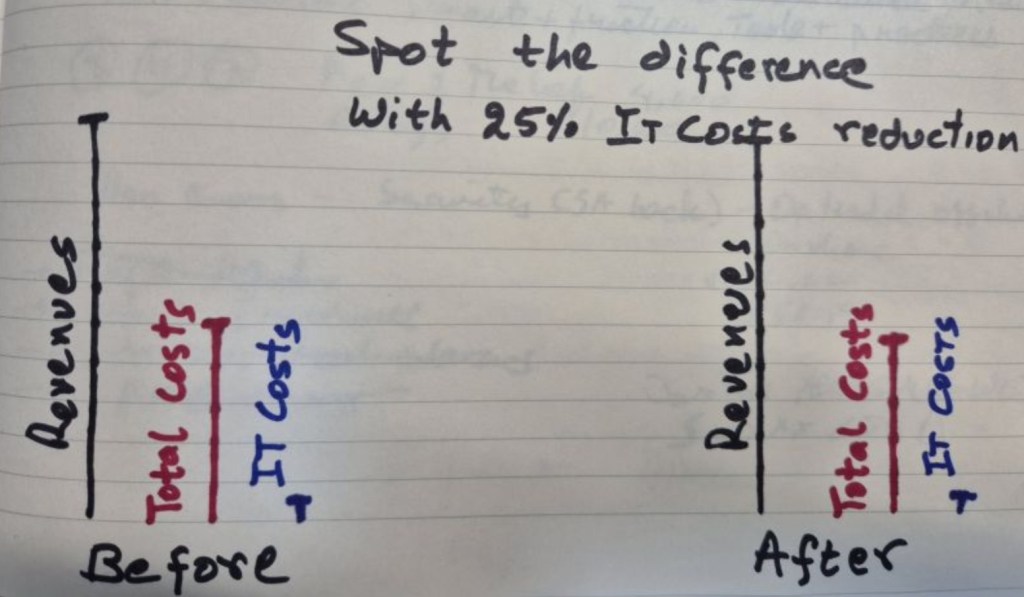
“𝐖𝐞 𝐧𝐞𝐞𝐝 𝐭𝐨 𝐫𝐞𝐝𝐮𝐜𝐞 𝐨𝐮𝐫 𝐈𝐓 𝐜𝐨𝐬𝐭𝐬 𝐛𝐲 𝟏𝟎%”, as a CIO when you hear this in an executive committee meeting, which of the following is the first thought that comes to your mind?
𝐇𝐨𝐰 or 𝐖𝐡𝐲
If the answer is 𝐇𝐨𝐰, you have taken costs reduction a foregone conclusion. If the answer is 𝐖𝐡𝐲, you may be in a position of debate with the executive committee on what matters most, cost reduction or economic growth?
Let’s assume that your firm’s total costs are 50% of its revenue and IT costs are 8% of the total costs. This means your IT costs are 4% of its revenues. Reducing your IT costs by 25% only reduces the firm’s total costs by 1%. So what dent will a 10% reduction in IT costs produce?
In this scenario, it would be better to focus on understanding how IT costs will grow as you grow your business. The aim should be for them to grow linearly with a gradient equal to or lower than the gradient of the business growth. Anything other than this and you are not growing your business sustainably.
Focusing on sustainable cost increase leading to economical business growth requires transforming your technology to scale granularly over an elastic infrastructure. That would provide opportunities for cost reduction as well.
AI’s impact on the cloud bill
Similar logic applies to AI costs.
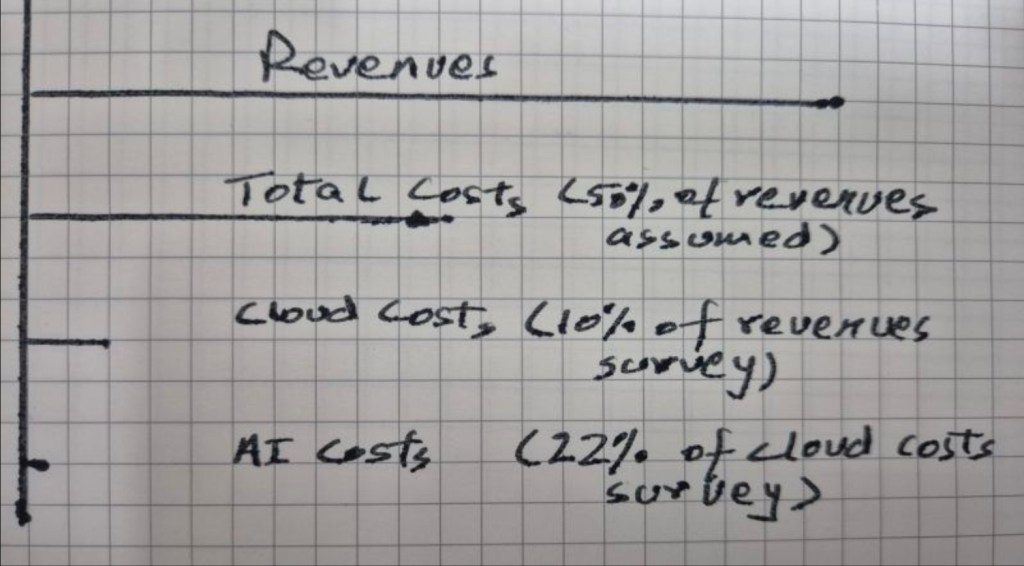
A survey of CFOs from 100 mid-size SaaS and IT companies suggests cloud costs rising to around 10% of revenues. This seems to be a sharp increase where 22% of these costs are attributed to the use of AI and machine learning. An immediate reaction is to start focusing on cost reduction. But is that the right first response?
Cloud and AI waste reduction is a no brainer. But if you are already running an optimised estate, you need to get a different perspective on cloud cost reduction.
Taking the numbers above and assuming total costs of a company as 50% of the revenues, if you want to reduce your AI and machine learning costs by 50%, it will reduce your cloud costs by 11%. The total impact on overall costs will be around 2% only. You may end up spending more effort to reduce your AI and cloud bill.
If you are worried about your cloud and AI bill on an optimised estate, you need to take a step back and understand what that spending is actually giving you.
Calculate your cloud and AI ROI and if that is not looking healthy, eliminate services and processing that are giving diminishing returns. Don’t just keep services running that give no commercial returns and spend money on the effort to optimise them.
Why do AI costs remain under a microscope?
Let’s take this into perspective. As mentioned above, industry surveys show AI costs making up 22% of cloud costs, and cloud costs being 10% of revenues of mid to large sized businesses.
That makes AI costs to be 2.2% of a firm’s revenue. A firm earning $1 billion is spending $22 million on AI. But their CIOs can only justify $4.4 million of that spend.
The remaining $17.6 million is the problem. This is the spend they cannot justify as they cannot tie that to business results.
The issue is not that the CIOs are spending too much on AI. The issue is that they cannot attribute the majority of that AI spend to business processes and workflows. As a consequence, they cannot help their businesses optimise AI usage and drive better returns.
Unlocking business value using AI requires understanding where it concentrates, how to release it and at what cost. This needs an intentional approach like the one described below:
1. Select workflows with operational leverage, e.g., heavy on volume, context or hand-off,
2. Identify and align metrics across activity, quality, workflow and business,
3. Baseline, instrument and measure workflows and business and not just activity,
4. Focus on total costs – including governance, human in the loop, maintenance and operations – and not just build costs,
5. Enable adoption with minimal friction and context switching.
This is not a project but an evolving operating model. Focus should be on increasing the ROI and not adoption. This will mean discontinuing AI in workflows that show diminishing or negative returns.
What does it take to have pragmatic IT cost management?
Many businesses focus on tools when trying to get visibility and control of their cloud and AI costs. But they still struggle!
Tools may give you visibility into your cloud and AI spend. This is the essential feedback you need to understand how much you spend on different workflows. But is this enough?
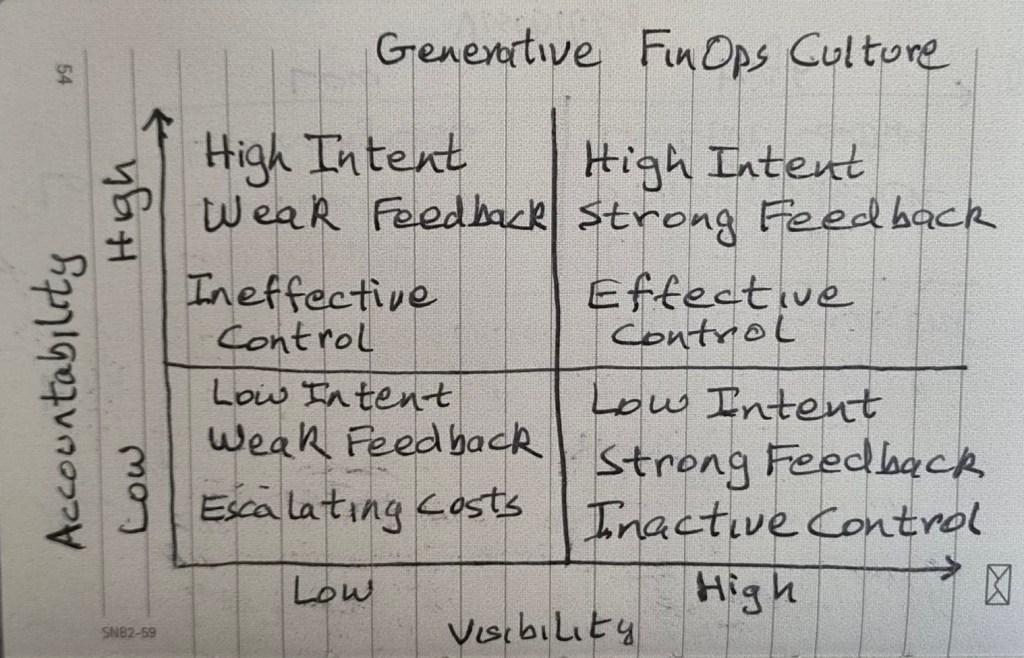
Additionally you need your teams to take accountability for acting on that feedback to address excess spend. A generative FinOps culture focuses on both high visibility and high accountability to effectively manage their cloud and AI spending.
Accountability with weak feedback leads to ineffective control. Conversely, strong feedback without accountability at worst leads to inaction.
Effective cloud and AI cost optimisation also requires:
1. flexible and scalable architectures,
2. platform and infrastructure automation,
3. lightweight and objective guidance and governance.
But without high accountability and high visibility, cost optimisation efforts will stall. Accountability should sit with and visibility should be provided to those closer to building and operating the systems. Governance and guidance should help them prioritise cost optimisations alongside delivering to business needs.
If you are intentional about controlling your IT costs pragmatically, you need to figure out which quadrant your FinOps practice sits in. It then enables you to move it to have both high accountability and high visibility. That is again an operating model change and not just a retooling exercise.
Conclusions
Rigid, arbitrary targets to slash IT budgets often inflict hidden damage on a firm’s core digital capabilities and long-term competitiveness. True optimization is not about executing blanket percentage cuts; it is about scaling infrastructure granularly, tying investments directly to unit economics, and demanding clear business attribution, especially for emerging areas like AI. By reframing IT expenditure against total revenue and enterprise costs, leadership can replace loss aversion and reactive panic with intentional, sustainable growth.

