

Most enterprises can save up to 40% of what they are currently spending on public cloud
Cloud largely charges for provisioning, not utilisation – a fine detail that many forget, leading to escalating wasted spend on public cloud. So it is not surprising that a 2025 study finds that nearly a third of businesses waste over 50% of their cloud spend due to under utilised resources.
While most businesses have mastered self service on cloud to scale and accelerate time to market, the same cannot be said for achieving the transparency to analyse, consolidate and economise their cloud spend.
Lack of situational awareness on cloud can be embarrassing for technology leaders. It may even hurt their personal career and growth perspectives as fiscal control and responsibility starts becoming a part of their KPIs. Building that transparency requires consolidating data from multiple sources. This should be front and center to cloud enablement as part of the cloud operating model, right besides technology skills and practices.
With cloud costs under a spotlight across the industry, FinOps and cloud costs management cannot be an afterthought. Focusing simply on contract negotiations to earn cloud discounts may only yield temporary relief. Once these discounts run out, further painful negotiations may be needed to avoid shocking price hikes.
Identifying and exploiting opportunities to right size environments, making them ephemeral and only provisioning them when required can bring substantial cloud economy. This requires both a culture that inculcates fiscal discipline across the organisation, and continuously improving technology and practices to surface and remove wasted cloud resources.
Taking only what you need
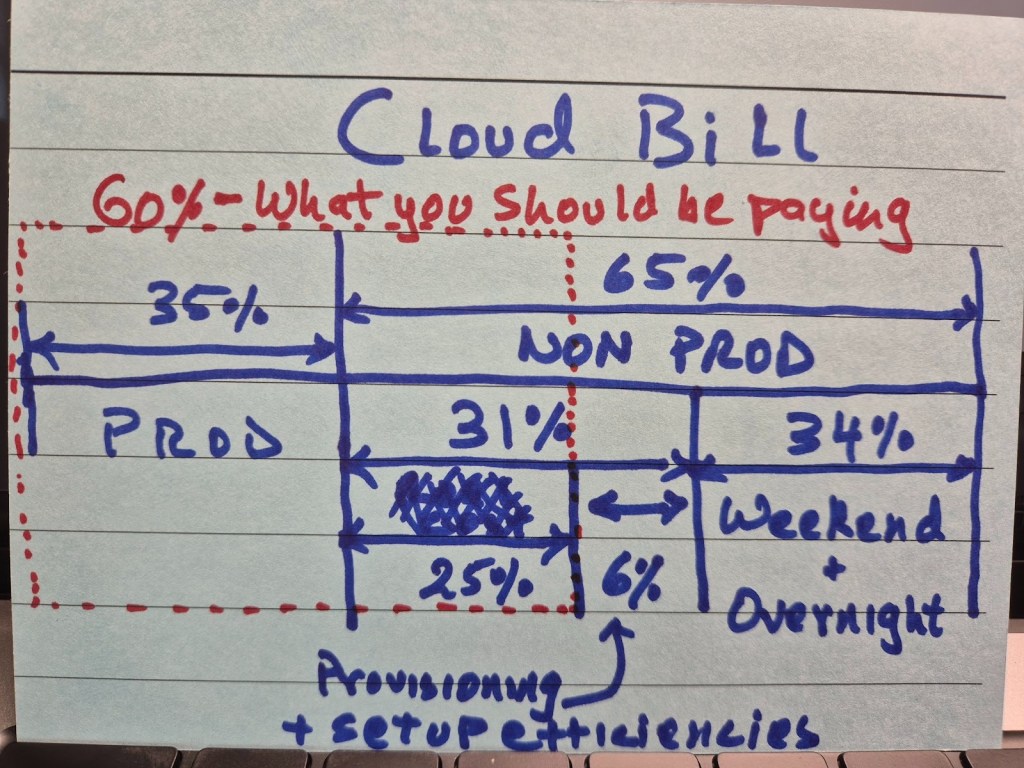
If your cloud bill is higher than your on-prem costs for the same infrastructure footprint, you could be saving up to 40% of what you actually pay!
Here’s what we worked out in a couple of hours of brainstorming – this may vary based on your circumstances but simple efficiencies can create real differences.
Think about your non-production environments. Typically your non-prod footprint will be at least twice the size, if not thrice, of your prod footprint. This means you may be spending twice as much on your non-prod environments, around 65% of your cloud bill.
But if you can make your environments ephemeral, you can spin them down overnight and on weekends (and public holidays). That should take away 34% of your cloud bill, if not more.
Then think about the duty cycle of your automated testing cycle – what proportion of your time do you spend testing vs preparing environments, deploying software and setting up test data? The longer it takes you to do all this set up, the longer your non-production environments are provisioned on cloud but are not doing anything meaningful.
Some estimates suggest teams spend up to 40% of their QA time in these preparations. Here we just took a nominal 6% saving with efficiencies in provisioning, deployment and data hydration. In many cases, this can be much higher.
There can be further non-prod savings, making your testing more efficient and reliable which would reduce your load on non-production environments giving you opportunities for further savings.
Levelling up with the business
From the very beginning, technology should try to get business and finance to expand the conversation from just cloud costs to include unit economics and margins. Unit economics focus on cost per unit of a business activity, for instance, cost per hundred thousand customers or cost per million transactions. This brings cloud costs in the perspective of business activity.
With an agreement on suitable unit economics metrics, technology can optimise systems to unit economics baseline. From there, any cloud cost increase should be seen in conjunction with the baselined unit economics. If unit economics metrics remain within tolerance limits of the established baselines, these higher costs are due to increased business volumes which should translate to higher revenues.
Once this level of maturity has been achieved, business and technology will work together to leverage cloud as a business enabler. Especially if systems have been decoupled and modularised to reduce scale-up costs, it will increase the extensibility and flexibility of the systems to provide business the agility it needs to pursue emerging market opportunities.
Going further with cost savings
Your cloud costs are bound to grow as your business scales. With an increasing number of customers and transactions, resource requirements for your applications will also increase, leading to higher costs. The challenge is how to keep the scale-up costs low and incremental. If these applications are monolithic and tightly coupled, scale-up costs can be high with potential wastage of infrastructure. Reducing scale-up costs and making them incremental requires modularising and decoupling your applications. Then only the bottlenecked services need to scale keeping costs and wastage low.
Modularising and decoupling monolithic systems into cloud-native services can be expensive and risky. Businesses may need to be convinced to invest in such modernisation with a compelling business case showing a strong ROI and payback.
Further, a complete modularisation may not be necessary to start with, perhaps only the business capabilities and services that process varying transaction volumes and those that change often. The remaining can be retained within the monolith. This may help the organisation gain further confidence on the path to improved cloud economics.
But a partial modernisation carries the risk of a fragmented technology estate and a bimodal IT organisation. If not managed intentionally, they can increase both costs and risks to the business. This usually involves continuously improving and optimising to reduce friction and increase confidence in delivering value to business, which may mean going further with modularisation and decoupling, if required, and adapting the engineering operating model to manage dependencies between teams.
 Banking on the Cloud